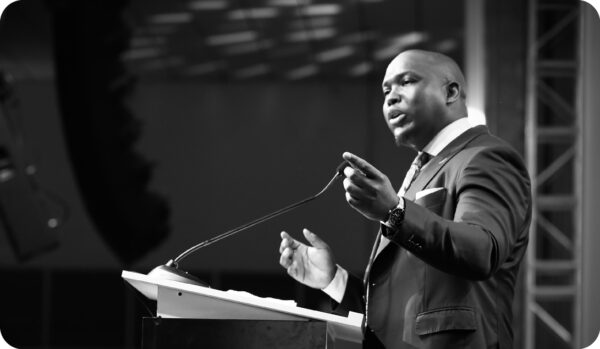
Vusi Thembekwayo Addresses Namibia Budget Dialogue 2026, Calling for Bold Leadership in Africa’s Next Growth Era
POSTED: March 2026
Windhoek, Namibia March 2026
Global entrepreneur and investor Vusi Thembekwayo delivered a keynote address at the Namibia Budget Dialogue 2026 in Windhoek this March, joining policymakers, business leaders and investors in a conversation about the country’s economic future and the opportunities emerging from its recent resource discoveries.
Hosted by Standard Bank Namibia, the dialogue brought together leaders from government, finance and the private sector to examine Namibia’s national budget and its implications for economic growth, investment and development.
Speaking to the room, Thembekwayo framed Namibia’s current moment as part of a broader continental inflection point.
“The continent we are in finds itself at an interesting time,” he told the audience, before drawing on experiences from global markets to illustrate how nations respond when natural resources reshape their economic trajectory.

Lessons from the Global Economy
Reflecting on a recent visit to Guyana, a small South American country experiencing rapid economic transformation following major oil discoveries, Thembekwayo shared a lesson that resonated strongly with Namibia’s own emerging energy sector.
Guyana’s leadership, he explained, had learned hard lessons about how resource concessions are negotiated and how national interests must be protected.
“They made it very clear,” he said, “that they wanted investors to come and do business there. But not at any cost.”
The experience, he argued, offers a useful framework for countries navigating new resource wealth. Natural resources may attract global capital, but the long-term value created depends on the terms under which that capital participates.
The Danger of Lowering Economic Ambition
During his address, Thembekwayo also cautioned against what he described as a quiet erosion of ambition in many African economies.Using South Africa as an example, he noted that recent celebrations around a 1.1% economic growth rate reveal how expectations can shift over time.
“That number is below population growth,” he said. “If anything less than about 3.6% growth happens, we’re not even touching the unemployment problem.”
For Thembekwayo, the issue is not simply economic performance, but national mindset.
“We get to the point where we celebrate outcomes like that when we start lowering our standards.”
A Personal Connection to Namibia
Part of Thembekwayo’s address also reflected a more personal connection to Namibia, citing his most recent trip at the end of 2025 to the country. The experience, he said, reminded him that economic policy ultimately has to translate into real outcomes for ordinary citizens.
“There are those of us who land at the airport and experience Windhoek,” he said. “But there is also Uncle Benny, whose life the budget must ultimately deliver a promise to.”
Budgets, he suggested, must go beyond numbers on spreadsheets. They must create homes, opportunities, education and economic pathways for people across the country.

The Role of Capital and Institutions
Another theme in Thembekwayo’s remarks was the role of financial institutions in enabling economic growth.
He spoke candidly about the tension that often exists inside banks between marketing ambitions and risk management.
While institutional discipline remains essential, he argued that economies also need room for calculated risk and innovation if they are to grow.
“If you pride yourself on taking no risk,” he said, “then you are also discovering nothing new.”
Africa and the Next Industrial Revolution
Looking ahead, Thembekwayo raised a broader concern about Africa’s place in the global economy. Historically, he noted, the continent has often been absent from the defining technological and industrial shifts that reshaped the world.
During the first Industrial Revolution, Africa’s resources were extracted and processed elsewhere. During the second, the continent largely watched the transformation from the sidelines. Now, as the world enters a new era shaped by artificial intelligence and advanced technologies, he warned that Africa must avoid repeating the same pattern.
“My concern,” he said, “is that we will do what Africans often do. We will call meetings, hold conferences, publish position papers but not take the capital risk required to participate.”
A Once-in-a-Generation Opportunity
Against that backdrop, Namibia’s resource discoveries represent what Thembekwayo described as a rare national opportunity.
“These resources are a once-in-a-lifetime find,” he said. “The question is how you extract them, multiply them, and build an oasis of a nation that will be very different from the one we see today.”
For him, the challenge is ultimately one of stewardship. Compliance and regulation may ensure stability, but they do not automatically create prosperity.
“Does the person who goes to bed hungry eat compliance?” he asked. “Does the entrepreneur with an idea build a business through compliance?”
Economic leadership, he argued, requires balancing institutional discipline with innovation and growth.

Preserving Identity While Welcoming the World
Closing his remarks, Thembekwayo praised Namibia for something he believes many countries struggle to achieve: remaining open to the world while preserving a clear national identity.
“You have a beautiful country,” he told the audience. “There is a purity here that is rare.”
He compared Namibia’s position to global cities like Dubai, which have leveraged natural resources to build international economic hubs while maintaining their national character.
“What they have figured out,” he said, “is how to attract the rest of the world while retaining what it means to truly be themselves.”
A Moment of Possibility
The Namibia Budget Dialogue forms part of an ongoing national conversation about the country’s economic future as new energy discoveries and investment interest reshape its outlook.
Coverage of the event and related discussions can be found across several platforms, including reporting by The Brief Namibia on the country’s economic reform trajectory:
https://thebrief.com.na/2026/03/namibias-budget-success-hinges-on-implementation-and-reforms/
Additional highlights and commentary from the event were shared across different online media:https://www.observer24.com.na/namibia-at-turning-point-in-economic-journey-shafudah/
For Thembekwayo, the moment represents something larger than a single budget cycle. It represents a question that many African countries now face.
How will the continent convert its natural advantages into long-term prosperity for its people?

For speaking engagements or media enquiries, visit www.vusithembekwayo.com